
Welcome to Early Years Foundation Stage (Rated ‘Outstanding’ by Ofsted, November 2023).
“Pupils enjoy warm relationships with adults and with their peers. They learn to take responsibility and to care for one another. This starts in the early years.” Ofsted, 2023.
Our Early Years Foundation Stage incorporates our Nursery and Reception Classes.
You can find out everything you need to know by clicking on the links below.
Please contact one of our Early Years staff members with any questions or concerns you may have:
Mrs Nicholls: rnicholls@st-johns-wetleyrocks.staffs.sch.uk
Miss Richardson: rrichardson@st-johns-wetleyrocks.staffs.sch.uk
Miss Goldstraw: egoldstraw@st-johns-wetleyrocks.staffs.sch.uk
Miss Riley: ariley@st-johns-wetleyrocks.staffs.sch.uk
Mrs Potts: gpotts@st-johns-wetleyrocks.staffs.sch.uk
Mrs Cheema: bcheema@st-johns-wetleyrocks.staffs.sch.uk
Miss Minor: bminor@st-johns-wetleyrocks.staffs.sch.uk
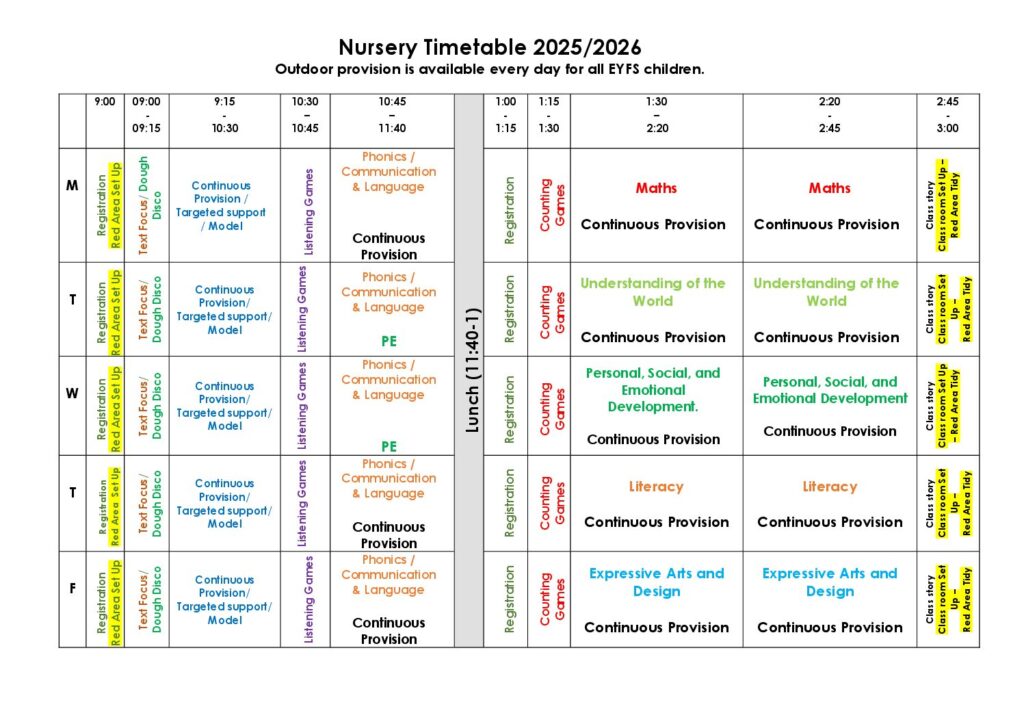
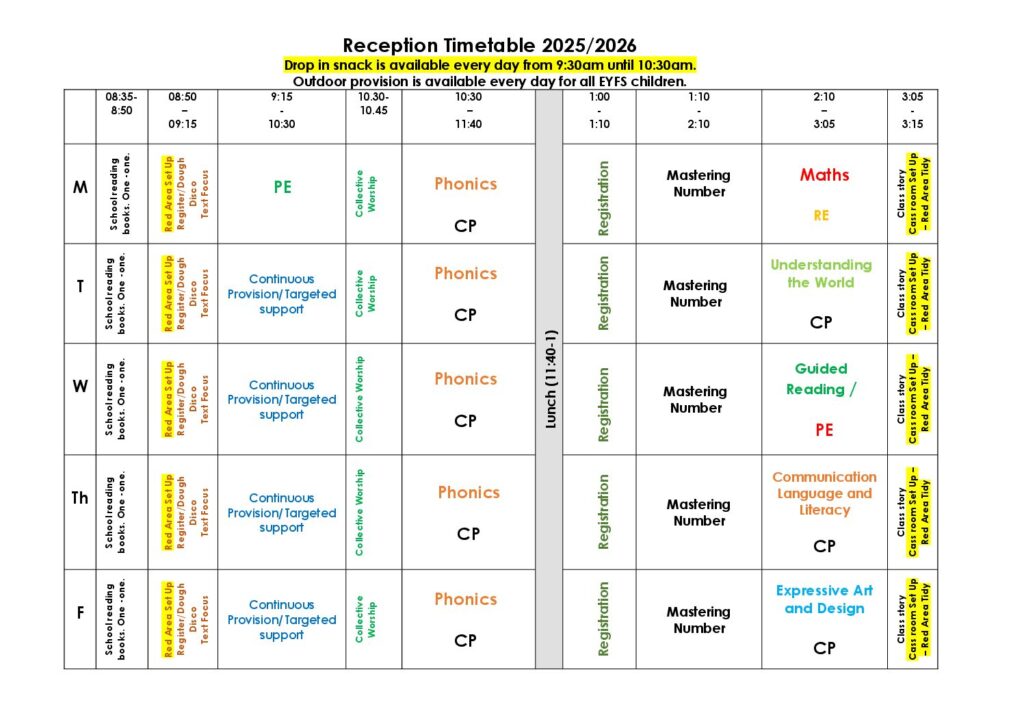
Reception Baseline Assessment Information For Parents – 2026
BBC Bitesize website – Starting primary school https://www.bbc.co.uk/bitesize/groups/cx1lpm3ve37t
My First day at School game – https://www.bbc.co.uk/bitesize/articles/zmkmdp3
Early Years Foundation Stage Framework 2026
The EYFS curriculum is split into Prime and Specific areas. The prime areas are important because they lay the foundations for children’s success in all other areas of learning and of life. The specific areas provide the range of experiences and opportunities for children to broaden their knowledge and skills:
The Prime Areas of learning are:
- Personal, Social and Emotional Development;
- Communication and Language;
- Physical Development.
The Specific Areas of learning are:
- Literacy;
- Mathematics;
- Understanding the World;
- Expressive Arts and Design.
At the end of the Reception year, pupils are benchmarked against the Early Learning Goals for each area. Attainment is described as either: emerging (working towards the expected level) or expected (working at the expected level) and these are reported to parents in the end-of-year written report. This is a change from previous years as, under the new Early Adopter framework, exceeding (working above the expected level) has been removed.
Changes to the Early Learning Goals (ELGs)
The most significant changes to the ELGs are in the areas of Personal, Social and Emotional Development, Mathematics and Understanding the World. We have attached the New Framework for September 2021 for you, but the key changes are:
Personal, Social and Emotional Development – ‘Self-Regulation’ has been a key focus recently and this is now reflected in a new Early Learning Goal. ‘Managing Self’ covers aspects previously covered within Physical Development. The ‘Building Relationships’ goal is very similar to the former ‘Making Relationships’ goal.
Communication and Language – ‘Listening, Attention and Understanding’ are now combined into one goal, with the other goal focusing on ‘Speaking’.
Physical Development – These Early Learning Goals no longer include health and self-care, solely focusing on moving and handling skills. There is now a goal for gross motor skills and a separate goal focusing on fine motor skills.
Literacy – There are now three early learning goals for Literacy, with the reading focus now split into comprehension and reading words.
Mathematics – The new Mathematics Early Learning Goals focus on a deep understanding of number and numerical patterns. Although there is no longer a goal for shape, space and measure the Government consultation response states, ‘Practitioners and teachers will still be required to teach children about shape, space and measures, as part of a well-rounded curriculum as set out in the revised mathematics educational programme.’
Understanding the World – The most noticeable change to the Early Learning Goals for Understanding the World is the inclusion of ‘Past and Present’ and the removal of the ‘Technology’ goal. We will continue to introduce children to appropriate technology to support their learning.
Expressive Arts and Design – The goals for Expressive Arts and Design are broadly similar to the existing goals with mentions of being imaginative and using a variety of materials, tools and techniques.
Here is document explaining what to expect your child will experience during their time in our Early Years classes.
At St John’s, we use the key person approach in our Early Years classes to help your children feel individual, cherished and cared for while they are away from home. This approach means that there is a named member of staff to act as the main point of contact for you and your child.
Your child’s key person can help you and your child by:
• Helping your child settle in when he/she first arrives at our setting.
• Making sure that any questions you have are answered.
• Helping your child with their personal care, e.g. toileting.
• Observing your child’s play and providing suitable resources and activities.
• Keeping up-to-date records about your child’s learning and sharing these with you.
• Encouraging your child to develop independent skills.
If you have any questions about the key person approach, or about how it will help your child, please just ask.